What is TOK?
¡¥We shall not cease from exploration, and the end of
all our exploring shall be to arrive where we started and know the place for
the first time.¡¦ T.S. Eliot
What is TOK?
Students entering the Diploma Programme
typically have 16 years of life experience and more than 10 years of formal
education behind them. As a result of both their academic studies and their
lives outside of the classroom, our students have accumulated a vast repertoire
of knowledge and a wide variety of beliefs and opinions, a process that will
continue at an accelerating rate throughout the two years of the IB. TOK,
however, provides students with an opportunity to step back from this
relentless process of acquisition and consider the knowledge they have gained in
a new light.
TOK is a course that aims to encourage students to
reflect on things that they have previously taken for granted; to critically re-evaluate
previously trusted sources of information; to challenge previously held assumptions,
prejudices and biases; to become more aware of the factors that have influenced
their perspective and the perspective of others; to become more internationally
aware, more culturally sensitive and to take a fresh look at the world around
them and see it in a way that they perhaps have not considered before.
As such the TOK course is very different to all
other IB courses. Some of the key differences are:
¡P
the
syllabus consists of ideas and questions to be discussed rather than
information that students have to learn;
¡P
the
classroom atmosphere is intended to be one of shared discovery and discussion
rather than one of instruction;
¡P
there is
no final examination;
¡P
there is
minimal assessment during the course consisting of one essay which is marked
externally and one presentation which is marked internally;
In the words of the IBO ¡¥The
TOK course is a flagship element in the Diploma Programme
which encourages critical thinking about knowledge itself to try to help young
people make sense of what they encounter. Its core content is questions like
these: What counts as knowledge? How does it grow? What are its limits?¡¦
TOK is not a philosophy
course. Although philosophical or theoretical questions may be considered, the
TOK course is grounded in the real world and we build on students¡¦ own
experiences and include them actively in the classroom by focusing on real life
concerns, current affairs and the knowledge issues affecting the lives of the
students involved.
Where does this fit in with rest of the IB?
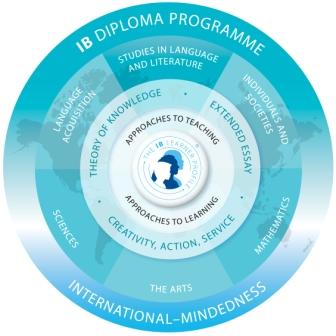
Along with CAS and the Extended Essay, TOK forms
part of the central core of the IB programme, as depicted below:
¡@
In conjunction with the Extended Essay, TOK can
provide the students with up to three bonus points that count towards their
final diploma total in accordance with the following matrix.
|
|
Theory of Knowledge Grade |
|||||
|
A |
B |
C |
D |
E |
||
|
EE |
A |
+3 |
+3 |
+2 |
2+ |
Fail |
|
B |
+3 |
+2 |
+2 |
+1 |
Fail |
|
|
C |
2+ |
+2 |
+1 |
0 |
Fail |
|
|
D |
2+ |
+1 |
0 |
0 |
Fail |
|
|
E |
Fail |
Fail |
Fail |
Fail |
Fail |
|
For example a student being awarded an A grade in
both TOK and the Extended Essay will score three bonus points, as will a
student who is awarded an A grade in one and a B grade in the other. In
contrast, however, a student who is awarded a B grade for both elements will
receive two bonus points while a student who is awarded C grades for both
elements will only receive one. Bonus points often help students achieve the
required number of points to enter their university of their choice.
One important fact to bear in mind is that attaining an E grade in either TOK or the Extended Essay represents an automatic failing condition for the IB Diploma.
What are the requirements?
¡P
All
students are required to study TOK for a total of 100 hours over the course of
the final two years at CDNIS;
¡P
In Grade
11 TOK is taught from just after the October Break until just after the Spring
Break;
¡P
In Grade 12
TOK is taught from the start of the year until the October Break during which
time students will produce the final presentation and essay on which their TOK
grade will be based.
What are the benefits?
Participation in the TOK course should help
students to:
¡P
develop
a fascination with the richness of knowledge acquired across a variety of times
and cultures;
¡P
make
connections between a critical approach to the construction of knowledge, the
academic disciplines and the wider world;
¡P
develop
an awareness of how individuals and communities work together (or separately)
to construct knowledge;
¡P
critically
reflect on their beliefs and assumptions and their experiences as learners both
inside and outside of school which will enable them to lead more purposeful and
responsible lives;
¡P
understand that
knowledge brings responsibility which leads to commitment and action.
And at the end?
Having followed the TOK course, students should be
able to:
¡P
identify
and analyse the various kinds of justifications used
to support knowledge claims, including their underlying assumptions and their
implications;
¡P
formulate,
evaluate and attempt to answer knowledge questions by constructing reasoned, logical and well balanced
arguments in defence of their point of view;
¡P
understand
how academic disciplines / the areas of knowledge generate and shape knowledge;
¡P
understand
the roles played by ways of knowing in the construction of shared and personal
knowledge;
¡P
explore
the links between knowledge claims, knowledge questions, ways of knowing and
areas of knowledge;
¡P
demonstrate
an awareness and understanding of different perspectives and be able to relate
these to one¡¦s own perspective;
¡P
explore
a real-life/contemporary situation from a TOK perspective in the presentation;
¡P
formulate
and communicate ideas clearly with due regard for accuracy and academic
honesty;
¡P
be comfortable sharing ideas with others and learning from
what others think.